How large-scale batteries are changing the NSW electricity landscape
Recent project acquisitions, construction progress and long-duration storage contracts are reshaping NSW's grid-scale battery landscape.
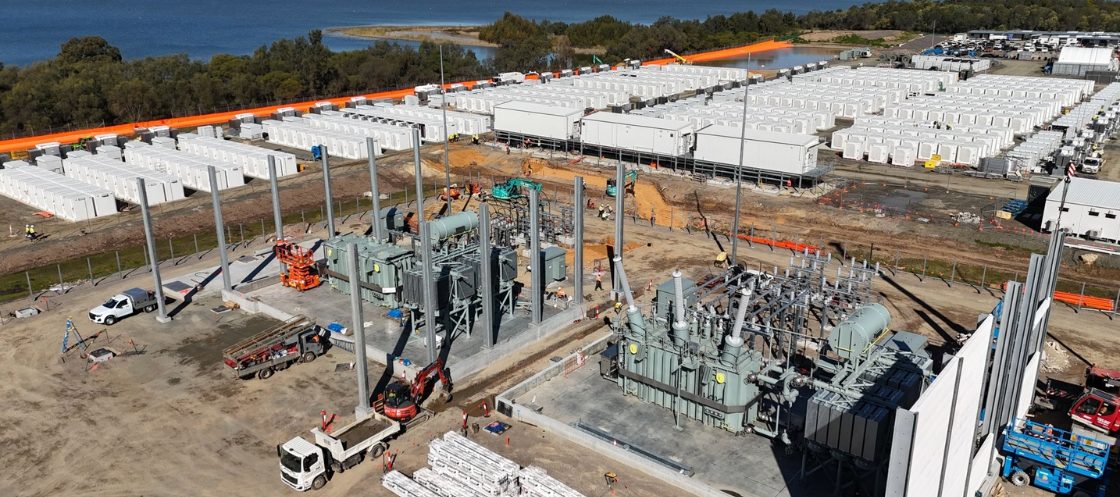
Some of the sites that have supplied NSW with electricity for decades are preparing for a different kind of working life. Instead of generating electricity from coal, they will increasingly store it for when it is needed.
In February 2026, the NSW Government reported that more than 200 battery projects were under construction or in the planning pipeline across the state. Since then, several major facilities have entered commercial operation, construction has advanced on others and further investment has been announced.
The rollout of battery energy storage systems (BESS) is occurring alongside the development of Renewable Energy Zones (REZs), upgrades to transmission infrastructure and preparations for the retirement of NSW's remaining coal-fired power stations.
Along the way, the batteries themselves are changing, with a growing number of projects designed to dispatch electricity for eight hours or more.
A second life for coal-fired power stations
Existing and former power station sites offer opportunities for battery developers through their proximity to established electricity transmission infrastructure and the potential to reuse industrial land.
At Liddell in the Upper Hunter, AGL completed final reliability testing of its 500 MW/1,000 MWh battery on 15 September 2026, more than three years after the adjacent coal-fired power station closed.
More than 700 workers contributed to the construction and commissioning of the project, delivered by AGL in partnership with Fluence Energy.
“The Liddell Battery is the first major development at the former thermal power station site,” said AGL Chief Operations and Construction Officer Matthew Currie.
On the Central Coast, the former Munmorah Power Station now accommodates the 850 MW/1,680 MWh Waratah Super Battery, which received approval from the Australian Energy Market Operator (AEMO) to operate at full capacity in September 2026.
Commissioned by EnergyCo and built by Akaysha Energy, Waratah performs a different function to many commercial battery facilities. Most of its capacity is reserved for a grid protection service, allowing more electricity to flow through existing transmission lines while helping protect the network against major disruptions.
At Eraring Power Station in Lake Macquarie, where coal-fired generation is scheduled to continue until April 2029, Origin Energy's first battery is operating with a capacity of 460 MW/1,770 MWh.
A second battery is under construction and expected to commence operations in the first quarter of 2027, bringing the combined capacity to 700 MW/3,160 MWh.
Origin is also seeking planning approval for an additional 500 MW battery on land adjacent to the existing battery development.
Further south, a proposed 400 MW/800 MWh battery at Vales Point Power Station is at the environmental impact statement preparation stage.
The repurposing of electricity infrastructure is extending into the Central West. Near Lithgow, Shell Energy's proposed Wallerawang 9 Battery would provide up to 600 MW of capacity at the former Wallerawang Power Station, subject to a final investment decision.
Nearby, EnergyAustralia has secured planning approval for up to 500 MW of battery capacity at Mt Piper Power Station. Its proposed 250 MW/1,000 MWh first stage has received support through the Australian Government's Capacity Investment Scheme.
Storage takes shape across the Renewable Energy Zones
While former power station sites offer opportunities to reuse established infrastructure, battery developments elsewhere in regional NSW are being located near renewable generation projects and the transmission networks that will service them.
In the Central-West Orana REZ, Akaysha Energy's 415 MW/1,660 MWh Orana Battery, near Wellington, entered commercial operation in June 2026.
Three further battery developments have secured access rights to the Central-West Orana REZ transmission network.
ACEN Australia's Birriwa Battery, Pacific Partnerships' Cobbora Battery and Lightsource bp's Sandy Creek Battery represent a combined network access allocation of 1,700 MW. Potentia Energy's Tallawang Solar Hybrid development, incorporating solar generation and battery storage, has also secured access rights.
These allocations establish how much capacity the projects can access on the REZ network and should not be confused with operational battery capacity.
In the New England REZ, EDF power solutions Australia announced on 19 November 2026 that it had acquired the proposed 250 MW/1,000 MWh Holloway Battery from SynCo Global.
Located near Armidale Substation, the project is targeting a final investment decision in late 2027, with operations expected to commence in 2029.
Battery storage also forms part of the proposed Pottinger Energy Park and Dinawan Energy Hub in the South West REZ. Both developments have secured access rights to the REZ transmission network.
In the Hunter–Central Coast REZ, OX2 is constructing the Muswellbrook Solar Farm and Battery on former coal mine buffer land, following its co-development with Idemitsu Australia. The project combines 135 MW of solar generation with a 100 MW/200 MWh battery, with completion expected in 2028.
Elsewhere in the Hunter, construction is progressing on AGL's $800 million, 500 MW/2,000 MWh Tomago Battery.
On 18 November, AGL confirmed that the first 100 of more than 400 battery units had been installed. More than 200 workers are involved in construction, with the project targeting completion in late 2027.
Bigger batteries are only half the story
When it comes to battery storage, size isn't everything. How long a battery can keep delivering electricity is equally important.
A battery's power capacity, measured in megawatts (MW), describes the rate at which it can deliver electricity. Its energy storage capacity, measured in megawatt hours (MWh), describes the amount of energy it can store.
A 500 MW battery with 2,000 MWh of usable storage could theoretically discharge at full power for four hours. Longer-duration systems extend the period over which stored electricity can be supplied when renewable generation is low or demand is high.
In February 2026, the outcomes of the sixth tender round under the NSW Electricity Infrastructure Roadmap were announced, with six lithium-ion battery developments receiving Long-Term Energy Service Agreements (LTESAs).
Together, the projects represent almost 12 GWh of storage capacity, according to AusEnergy Services Limited (ASL) Tender Round 6 outcomes.
The agreements provide revenue underwriting to support investment in the developments, which the NSW Government expects to be completed by 2030.
“An important objective of the Roadmap was to bring-forward investment in long-duration storage, and that’s what we’re seeing,” said ASL Chief Executive Officer Nevenka Codevelle.
Further investment is being pursued through tender rounds eight and nine, which opened in May 2026 seeking an indicative 2.5 GW of renewable generation and 12 GWh of long-duration storage across NSW.
Beyond lithium-ion
While lithium-ion technology accounts for the six successful projects in the latest long-duration storage tender to report outcomes, alternative battery technologies are also being investigated in NSW.
Among them is Idemitsu Australia's proposed Hunter Vanadium Flow Battery, an early-stage development at the former Muswellbrook Coal Mine with the potential to provide up to 108 MW/864 MWh of storage.
Unlike conventional lithium-ion batteries, vanadium redox flow batteries store energy in liquid electrolytes held in external tanks, allowing power and storage capacity to be scaled separately.
The technology has its roots in Australian research, having been developed at the University of New South Wales during the 1980s.
Idemitsu has identified potential opportunities for Australian manufacturing through the supply of vanadium electrolyte for the proposed development.
Connecting the pieces
Batteries cannot replace coal-fired power stations on a like-for-like basis. They store electricity rather than generate it, making their contribution to the energy transition dependent on the availability of generation and the infrastructure required to move electricity around the network.
On 23 November 2026, EnergyCo announced that Transgrid had been awarded the contract to deliver the 110-kilometre, 500 kV Hunter Transmission Project.
The transmission line will increase network capacity and help connect renewable generation and storage in the Central-West Orana and New England REZs with electricity consumers across NSW.
EnergyCo expects the project to create 900 jobs during construction.
The concurrent development of generation, storage and transmission infrastructure presents opportunities for NSW businesses across electrical engineering, civil construction, equipment supply, transport, logistics, environmental services and asset maintenance.