New TRaCE microcredential opens pathway into hydrogen sector knowledge
A new free, self-paced microcredential developed by TRaCE in partnership with Dr Quentin Meyer and issued through UNSW aims to build foundational knowledge of the hydrogen economy while supporting workforce capability for clean energy and recycling industries.
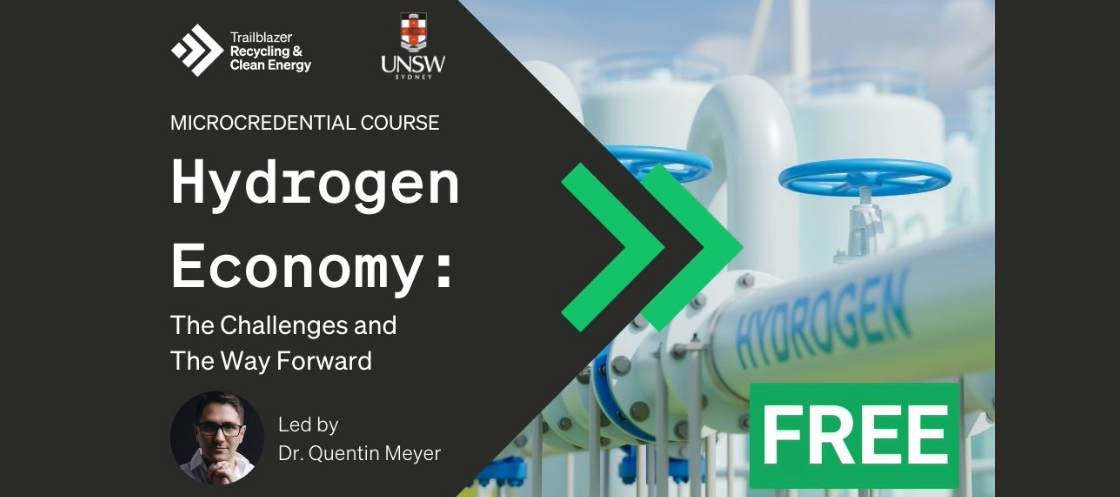
The Trailblazer for Recycling and Clean Energy (TRaCE) has released a new online microcredential focused on the hydrogen economy, developed with Dr Quentin Meyer, Senior Research Fellow at the School of Chemistry at the University of New South Wales (UNSW) in the Nanoelectrochemistry Lab.
The course is designed as an introductory program to help participants understand the technical and industry context of hydrogen as part of the transition to net-zero emissions. Delivered online and available at no cost, the training is self-paced, allowing learners to engage with the material flexibly while building core knowledge relevant to clean energy and related sectors.
What the course covers
The program provides an overview of key concepts across the hydrogen value chain. Content includes the fundamentals of the hydrogen economy, the different types or “colours” of hydrogen, and the technologies used in production, transport and storage.
Participants also explore green hydrogen electrolyser systems, hydrogen fuel cells, applications across industries, and emerging trends shaping the sector. Assessment is completed through a multiple-choice format designed to confirm understanding of the core material.
Microcredentials as a workforce tool
The hydrogen course sits within the broader TRaCE Microcredentials program, which focuses on short, targeted training in clean energy, recycling and sustainability technologies. These courses are developed with input from industry and academic partners and are structured to provide practical skills that can contribute toward formal qualifications.
TRaCE positions the microcredentials as a way to build specialised capability across Australia’s workforce, supporting people already working in technical fields as well as those seeking to transition into new areas linked to decarbonisation.
Role of UNSW and learning outcomes
Issued through UNSW, the course sets out to provide a foundational understanding of how hydrogen fits into the broader shift toward lower-emissions energy systems. Learning outcomes include familiarity with hydrogen production pathways, storage and distribution methods, and the implications of future industry developments.
By combining introductory theory with sector context, the course aims to equip participants with baseline knowledge that can support further study or entry into hydrogen-related roles.