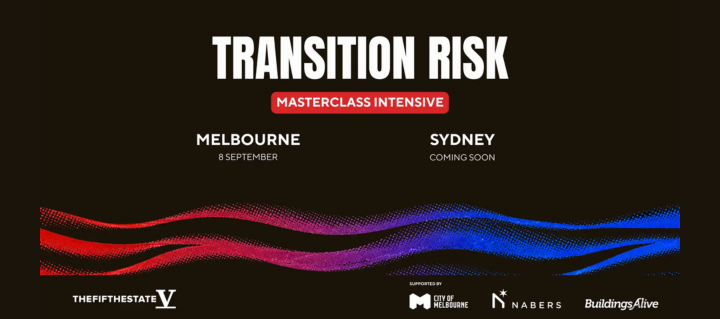
Transition Risk Masterclass Intensive Melbourne
How to capitalise on new energy, electrification and ESG reporting
If you’re a professional working with major private or public real estate assets, you’ll know there’s a world of pain for your property clients if they can’t navigate the net zero transition underway.
They face being landed with stranded assets.
Your competitive opportunity now is to understand the transition risks underway and provide a seamless plan and solutions for success.
This masterclass is your key.
It will unlock what great looks like for the C-suite you need to make a big impression with.
Whether it’s the chief executive who wants to know if your work aligns with Australian Sustainability Reporting Standards. And whether the tenants are locked in and the investors are comfortable with the mid to long term plans you’ve created.
Maybe they’re worried about the broader stakeholders and whether they’ll like all those boxes you’ve ticked on sustainability and net zero.
The chief financial officer might want to zero in on the energy crisis and what you’ve got planned for alternative clean and cheap energy.
Policies and incentives are moving rapidly
You’ll need to have a grasp of the industry and government policies that are evolving at a rate of knots, and also what new financial incentives and programs, such as from the City of Melbourne, the CEFC and other financiers, are available to help with electrification of the asset you own or manage.
There’s so much at stake now. And time is of the essence.
Steve Ford – MC
Designed by one of the property industry’s most highly regarded professionals, Steve Ford, this is the masterclass calls on Steve’s decades of experience in the industry, including 12 years at GPT where he led that property giant’s own net zero strategies.
If you work with offices, retail, industrial, universities, health, cultural or other public assets, you’ll benefit from the insights Steve has curated with other leading professionals who will share with you some of the deepest and most practical experiences you’re likely to find in the industry.
There will be lots of learning but also plenty of time for questions and a chance to test answers with a like-minded cohort of your peers. Not to mention the chance to network with your industry peers and learn even more informally.
You never know what valuable kernel of knowledge you’ll pick up at these events!
WHO SHOULD ATTEND?
This masterclass has been designed for property owners, asset managers, energy efficiency and electrification specialists, facility managers, capital works managers, sustainability professionals, risk managers, fund managers, or disclosure and reporting managers. You need a seat at this masterclass.
THEMES COVERED
Mandatory compliance
Australian Sustainability Reporting Standards (ASRS) now mandate clear disclosure of your strategies to manage an orderly transition plan to a low carbon energy future
Market volatility
Doing nothing exposes your portfolio to an increasingly erratic energy market and sudden price spikes. Tenants and investors can flee buildings that don’t meet expectations
Capital risk
The lack of a viable plan could mean being forced to act outside your normal capital planning cycles, leading to exposure to higher retrofitting costs
WHAT YOU'LL LEARN
This masterclass will be an essential part of your success story. It will empower you with practical solutions so you can build your own skills and business – and make your clients happy.
Session 1: Why this matters – energy and carbon trends will impact your organisation
An overview of the energy, carbon and related policy trends in the context of governance, strategy and risk management. There’s legal exposure, reporting metrics and targets for your business strategy to consider. Impacts will be across all asset classes, so you need to be aware and prepared.
Session 2: The business and value case for your energy transition
Engineering and finance: Build a plan to consider contingent liabilities and technical problems. Tackle functionality over the lifecycle of assets to avoid stranded assets; efficiency as productivity, and passive versus engineered solutions. Consider policy and green finance drivers, legal and financial implications (ASRS requirements), business and value case; durability and flexibility for long term value; lifecycle triggers
Session 3: Holistic planning
Your energy transition plan needs to maximise long term value creation. Look at the big picture; considering each element in isolation can be detrimental. It is as much a financial challenge that considers contingent liabilities and long term asset values, as it is a technical problem. Look for the opportunity where there is risk and look over the horizon to avoid stranded assets. Consider: efficiency is productivity; passive versus engineered solutions; durability and flexibility are also important to create longest term value.
Session 4: Electrification and key triggers for actions
Key processes, benefits and challenges in electrifying buildings. How electrification will impact your NABERS ratings. Implement the building reviews necessary before electrifying to avoid unintended consequences. Use life cycle planning to align complementary projects
Session 5: Demand side flexibility
Learn how to best manage imbalances in supply, demand and networks and maximise usage when electricity is cheap, green and abundant. Plan for future space needs such as for EV charging and densification. Prepare a business case for a transition plan and learn how to communicate the strategy for stakeholder buy-in.
Session 6: A practical approach to your energy transition
Building optimisation: setting goals that make sense and target setting processes. Monitor processes and touchpoints with your operation; key things to look out for with tenants and your future needs’ data for optimisation and reporting. What to look for in a business – the projects that always get approved; the projects that fail to get approved and why.
Session 7: Energy Transition Projects – Case studies
Case studies in electrifying heating and hot water at a fraction of regular costs. Alternative heating options, planning for resilience; electro-retrofits case studies. The impact on gas emissions and NABERS. Preparing the business case.
Session 8: The Final Steps – a fully rounded plan
Beyond transitioning the energy needs for your building’s infrastructure, tenants and customer needs must also be considered. This session looks at the implications of electrification of vehicles and cooking. Identify key goals for a variety of uses and avoid the “death spiral” of rising costs. Key considerations: food services (gas cooking viability), transportation (EV charging) and construction (embodied carbon scrutiny)