Newcastle-made printed solar moves from research to pilot manufacturing with federal backing
Federal funding will support the transition of Kardinia Energy’s printed solar technology from long-running research into a commercial pilot, with plans for new local manufacturing capability.
Kardinia Energy has secured $2.15 million through the Australian Government’s Industry Growth Program to support the next phase of development for its flexible printed solar technology.
The funding is intended to progress a commercial pilot aimed at scaling production of the Newcastle-designed product, which uses printing processes rather than conventional silicon manufacturing.
Announcing the investment at the Newcastle Institute of Energy and Resources on Wednesday, Minister for Industry and Innovation and Minister for Science Tim Ayres said the support would help move the technology toward manufacturing in Australia. He said, “It’s extraordinary technology with applications in all parts of the energy system … I’m looking forward to seeing the next stage of this development moving towards commercial production and manufacturing here in Australia.”
Technology built on decades of research
Printed solar has been developed over roughly 30 years, progressing from small laboratory devices to large demonstration installations with commercial partners.
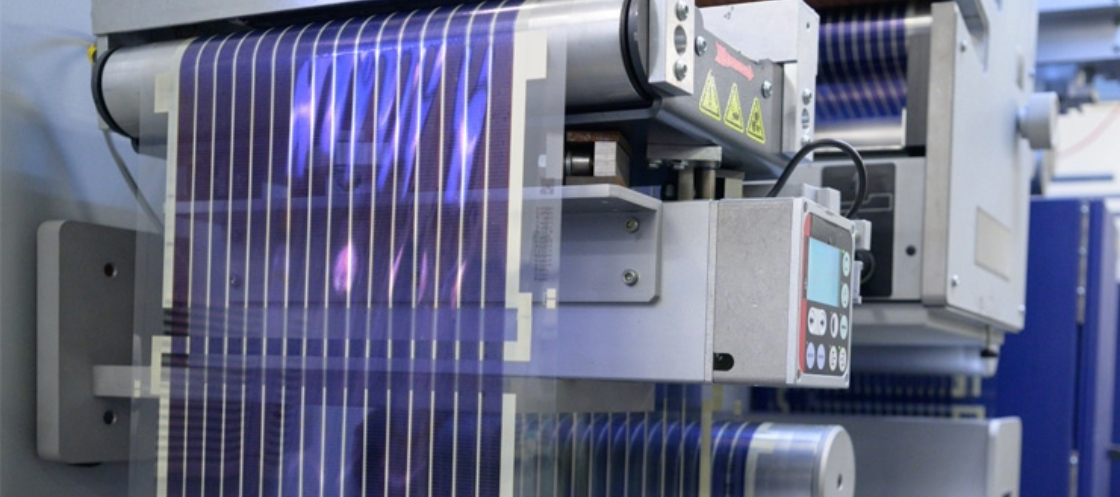
Professor Paul Dastoor, who leads the research behind the technology, said the process uses electronic inks printed through roll-to-roll systems to create energy-generating materials. He said, “And finally, when that product is finished, it’s 100 per cent recyclable.”
The technology uses carbon-based semiconducting polymers printed onto recyclable plastic, rather than silicon wafers, which reduces manufacturing energy requirements and enables lightweight, flexible products.
Manufacturing pathway and timeline
According to Kardinia Energy and the project team, the new funding will support the design and installation of additional printer equipment to increase production capability and improve device performance.
Project timelines discussed at the announcement indicated equipment delivery could occur within about nine months, with a new facility operating in roughly 18 months. The manufacturing site is expected to be located in or near the existing Newcastle research base.
The commercial pilot is intended to open the door to larger-scale investment and future production capacity measured in megawatts.
Applications across multiple sectors
Printed solar is designed to be lightweight, flexible and fully recyclable, allowing deployment in locations where traditional panels are difficult to install.
Kardinia Energy states the technology can be used across a range of settings, including industrial buildings, remote locations and temporary installations. Demonstrations have included supplying power for concert infrastructure, with the technology previously deployed during Coldplay tour events.
The company says the product’s design allows it to be installed, removed and recycled with relative ease, while its lower manufacturing cost profile is aimed at expanding the range of viable solar applications.
Newcastle research and industry context
Speakers at the announcement linked the project to the broader research and manufacturing ecosystem in Newcastle and the Hunter, including collaboration between universities, research organisations and industry.
The funding forms part of a broader effort to move locally developed energy technologies beyond the research phase and into commercial production, with the printed solar project positioned as one example of that pathway.
Kardinia Energy said the grant supports its objective of bringing the technology to market while continuing development of performance and manufacturing capability.